

Why?
The spirit of this week’s prototype is to ask as many questions as possible about our project. This exercise helps us to clarify our goals, identify potential challenges, and explore new ideas that can enhance the overall quality and impact of our work. By questioning every aspect of our project, we can ensure that we are making informed decisions and staying aligned with our vision.
Ever since coming into NYUAD, which back then felt like a dream, and to some this place feels like heaven. But after four years of tempering, I began to be cautious of my complacency and notice the “off” feeling generated by the space that occupies this campus.
To further elaborate, the way that the campus space is designed encourages all communities to interact, engage, and bump into each other (learn more about the architect here). While this (arguably) creates a close-knit vibe, having been exposed to this phenomenon everyday eventually tires everyone out.
Second, I noticed that there’s a lack of places to truly chill down on campus apart from (maybe) our dorm rooms, which at times could be chaotic. By a place to chill down, is as I define: a place where you are encouraged to NOT be productive at all, little to no social interaction, and just be there for ourselves to think about the present rather than the future or the past.
With this capstone, I would like to challenge (and perhaps) address this notion by accommodating cozy spaces for everyone. Essentially, after having so much productivity, it’s time to chill, sit back, and relax. So yeah, this is the oomph that will keep me going to materialize this project and bring it to reality from dreams.
Why: Cozy Corner?
We wanted to make a project that focuses on mental health and well-being, especially in a college setting. The name “Cozy Corner” reflects our goal of creating a comfortable and inviting space where individuals can relax, unwind, and find solace from the stresses of academic life.
The term “Cozy” evokes feelings of warmth, comfort, and security, while “Corner” suggests a designated area or nook where one can retreat for some peace and quiet. Together, “Cozy Corner” encapsulates the essence of our project as a sanctuary for mental rejuvenation and self-care.
Why (not): Meditative?
Instead of creating a meditative spot, we wanted to focus on creating a space that encourages relaxation and comfort without the structured practices often associated with meditation. Also, we noticed through observation that the campus space itself lacks relaxation areas, so we wanted to fill that gap.
Why: TouchDesigner?

With the vision of creating a room that is both relaxing and interactive, we decided to use TouchDesigner as our main tool for prototyping. TouchDesigner is a powerful visual programming environment that allows us to create real-time interactive multimedia content. Its versatility and flexibility make it an ideal choice for designing immersive experiences that can respond to user input and environmental factors.
Why: Projection?
We are dealing with a space (a room in this case) where users can come, look at the installation/artwork, and then interact with it. We want the experience to reflect the user’s input and behavior. To allow one’s immersion to be heightened maximally, we could do few options:
- Virtual reality
- Haptic feedback
- Big visuals
After some thoughts and discussions with our group members, we really wanted to try out something new and decided to pursue using Big Visuals that is wall projection mapping. We wanted this entire capstone process to be both enjoyable and fun learning experience.
Why: AI?
This is a debate that has been going on between our members, at least. The use of AI is intriguing in our case because: why not join the AI hype bandwagon? In one hand, AI helps us a lot by actually providing more choices for the user without strictly limiting ours. It also helps us by reducing our workload so that we don’t have to come up with so many different algorithms to keep up with what the user can do in our space.
At the same time, it also prompts us a question: “How necessary is it to use AI in our project?”
Can there be an alternative where AI is not used in our project and we rely solely on the choices provided for the user? How many we are going to provide (in the sense on how broad it is?) These are some questions we have to tackle.
Prototype 3 » Dispersion: Image-to-particles
For this week’s prototype, I wanted to explore a path that is Particles System offered by TD. Specifically, since Yaakulya is working on text-to-image, I am working on the processing part, where by feeding an image to a particle system, it will ‘reform’ and shape into a new output.
How Prototype 3 Works
Essentially, how the prototype works is that it takes an image input, a vertical, and a horizontal ramp. Then, we compose all three into three separate values for X, Y, Z. This allows us to determine the coordinates which can be used by the particlesGpu Palette where we can then add more parameters to adjust how the final output looks.
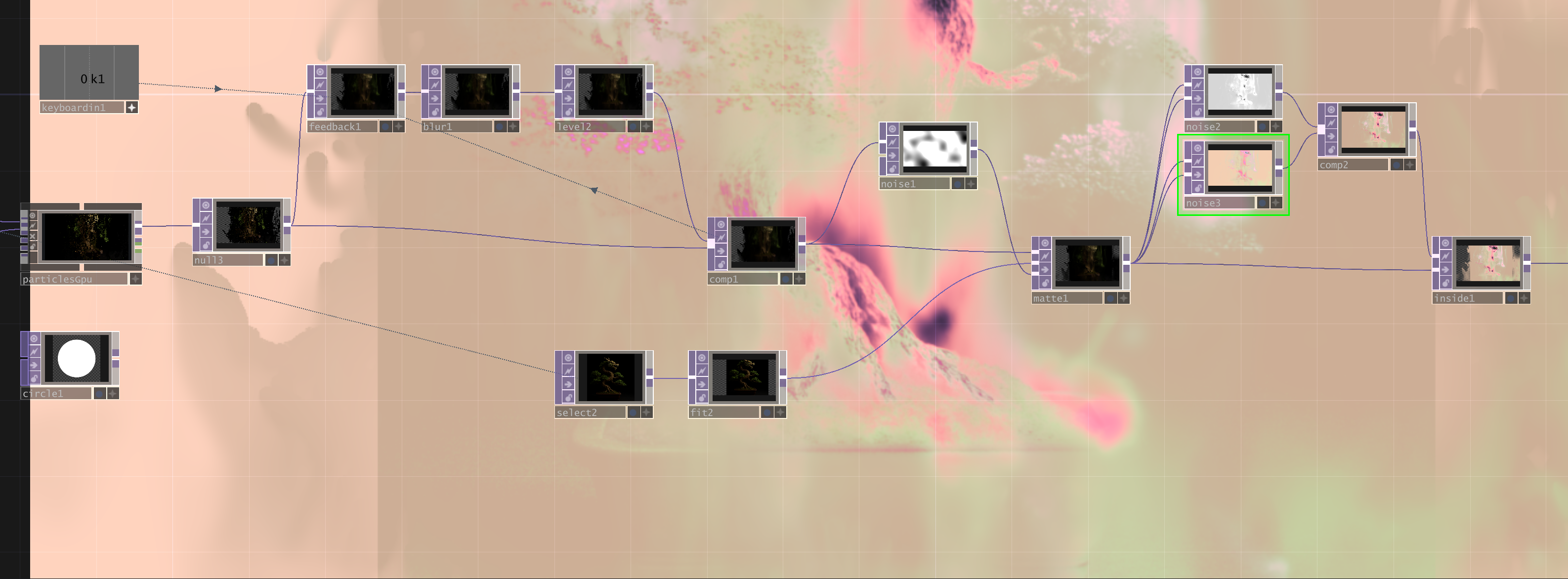
In the parameters, I added noise, matte, and blur to change the very colorful ice cream and bonsai tree to a uniform color.
Of course, for the future, I will adjust these colors to suit more ‘calming’ vibe
Next Steps
For the next prototypes, I wanted to finally incorporate “calm vibes”. To actually do this, I first have to read some materials on what calm is, how space, color, and other factors play into making people calm. As an initiative, we are planning to meet Professor Khulood Alawadi, an expert in design field on campus to discuss further and see if we can take this project somewhere! Super excited in what the future entails.