

Recalibrating our Culture Anchor
Steampunk
Although I cannot call myself a devout “steampunker”, I very much enjoy narratives and world building on this specific vision of alternate realities. Partially because I do not find tall skyscrapers shrouded in thousand-glimmering neon lights to be enticing compared to mechanical whirrs, clanks, and lung filling steam, but because it is an era we will never see again.
Unhinged take but our world today takes shape after modernism and standardism in the sense that a lot of things are shaping from this culture. Most of the ideas came from the West, and through long history, is applied in almost every inch of the world with varying “success”. **Take for example McDonalds. **All across the globe, they have transformed from a red-yellow playful hunger-grabbing food sites into a souless concrete structure with a yellow “M” sign posted somewhere in the vicinity.

Knowing this, it also applies to steampunk in the discourse that steampunk works are often set in an alternative history of the Victorian era or the American frontier where steam power remains in mainstream use, or in a fantasy world that similarly employs steam power. Authors like Jules Verne, H. G. Wells, Mary Shelley, and Edward S. Ellis contributed to the popularity of the genre. But just because the idea popularized in the “West”, does not mean the “East” have no steampunk.
I took a look into Beyond Victoriana’s question based on this post:
If nineteenth-century Iranian women discovered time travel, where would they go? What would they bring back?

The first thought that came to my mind was when?, simply because the time assuming was following our current timeline would create very interesting dynamics. Think about the war, the conflicts, and everything that the people had to experience that changed the values of a very deeply rooted community. But looping back to the idea behind Beyond Victoriana, I think this was a very peculiar one. It’s just that paralel-ly, steampunk has a very ingrained definition already through scenes and imaginatives from the West that calling some of the East to be also steampunk takes bravery.
Gulf x Oil
Questioning about the future of the Gulf, oil comes into my mind. One way to ask is tapping in realms of relationship between gulf and oil. Before it was found, while, and present day implications. Artists Rania Ghosn and El Hadi Jazairy in After Oil engaged me in this discourse.
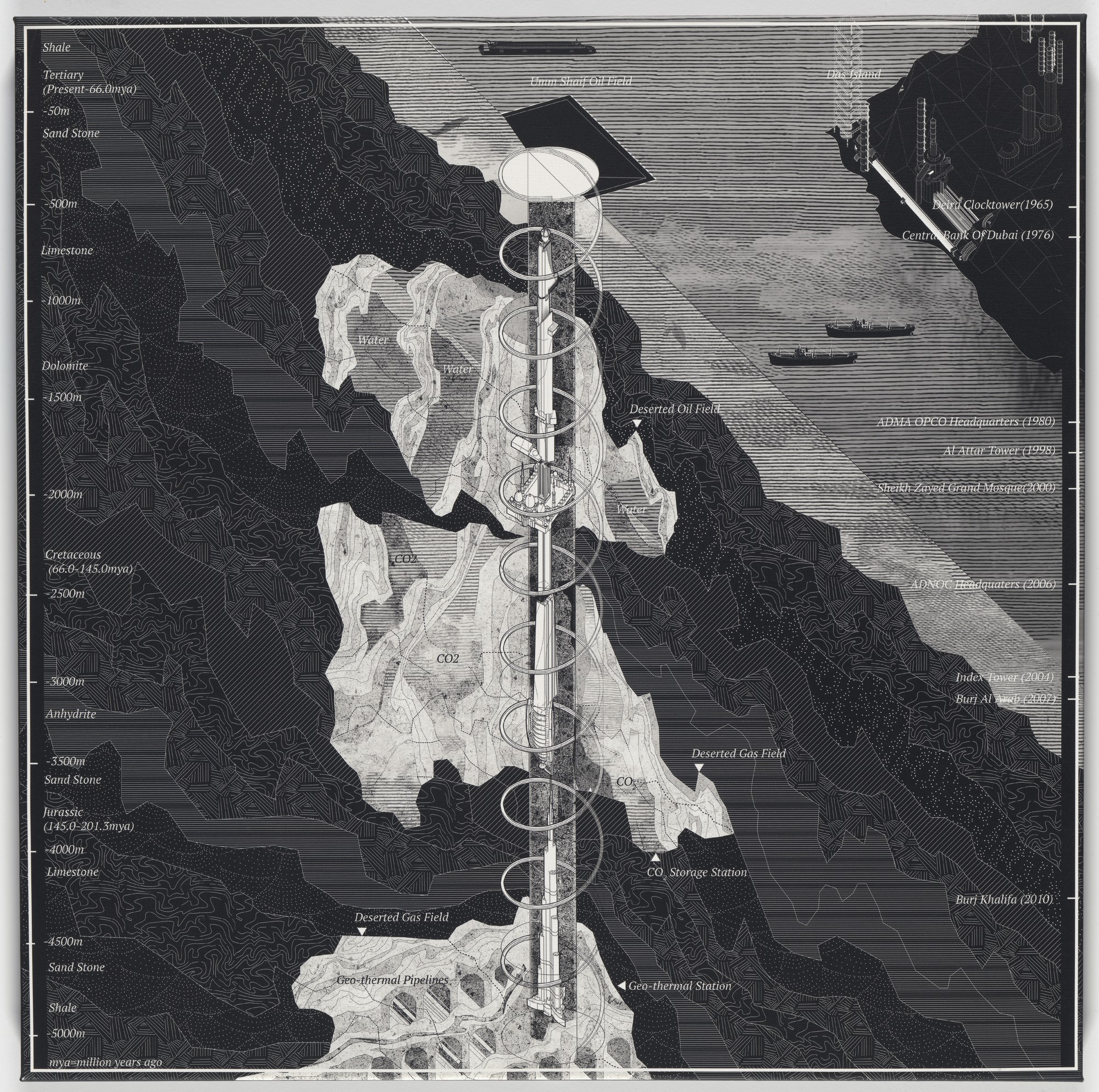
The drawing shows Das Island, a major oil-processing site in the UAE, but it mixes together geological time (millions of years) and modern architectural time (the last few decades). On one side is the slow history of the Earth’s rock layers, and on the other is the fast rise of famous UAE buildings like Burj Khalifa, Sheikh Zayed Mosque, and Burj Al Arab. In the middle, inside a giant drill hole, the drawing stacks these iconic buildings inside the empty oil reservoirs, visually connecting the oil underground with the futuristic skyline above.
It also hints at a missing historical moment: the societies of the Gulf jumped very fast from pre-oil life to modern cities, creating a temporal gap. The artwork encourages us to rethink the future of the Gulf, not as something predetermined by oil wealth or dystopian collapse, but as something open, uncertain, and needing new imagination. It mixes past, present, and future to push viewers to reconsider our relationship with the Earth.
both are thinking about time, and in exchange, I thought about just how much shifting waves colonialism has brought upon the world.